D1 Evolution
Jordan Valley’s D1 Evolution is the latest generation of flexible X-ray diffraction instruments for thin-film materials research, process development, and quality control.
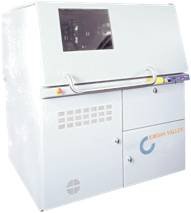
-
- High intensity with high resolution
- Automation of sample alignment, measurement and analysis
- Works with leading edge analysis software (RADS for HRXRD, REFS for XRR) for accurate and fast analysis (worldwide proven with over 100 installations)
- Automated tool alignment (source and detector optics) between multiple configurations to optimize system intensity and resolution for each measurement type:
- Supports wide range of thin film applications:
- HRXRD: Thickness, Composition, Relaxation and Strain measurements in epilayers
- XRR: Thickness, Density and Roughness measurements of thin films. Pore size measurements of porous films.
- WA-XRD: Phase, Crystalline texture, Crystallinity, Residual stress, Grain size of polycrystlline thin films
- XRDI: Crystalline defects, Slip bands, Edge cracking / chips, Dislocations
- Area uniformity (wafer mapping) for all measurements
- No calibration samples required: X-ray metrology techniques are absolute
Please use this form to request product brochures
Jordan Valley’s D1 Evolution is the latest generation of flexible X-ray diffraction instruments for thin-film materials research, process development, and quality control. Featuring fully automated source optics, the system can switch between standard XRD, High-Resolution, and X-ray reflectivity modes without user intervention. Measurements can be run in partial or fully automated modes, with user-customizable scripts handling the routine work. The instrument is designed for a variety of thin-film applications, including high resolution rocking curves, reciprocal space mapping, X-ray topography (digital imaging), X-ray reflectivity, Grazing Incidence XRD, Phase ID, residual stress, film texture and grain size analysis. The sample stage consists of a robust 5-axis Eulerian cradle, with 150 mm wafer mapping, and capacity for both large and small samples, and multi-sample locations. Leading edge data analysis packages, such as RADS and REFS provide expert data presentation and interpretation. The D1 Evolution is the ideal, multi-application thin-film materials research tool – for now and into the future.
The D1 is a materials research and development system for 200mm processes and below. Intended for use with Silicon, III/V, SiC, LED, Solar, Research and Development, & Universities.
The D1 Evolution can be used for virtually any thin film analysis. Some of the parameters which can be measured are:
-
- Thickness
- Composition
- Relaxation
- Strain
- Area uniformity
- Density
- Roughness
- Phase
- Crystalline texture
- Crystallinity
- Residual stress
- Pore size
- Grain size
- HRXRD, relaxation and XRR of Epitaxial films (SiGe, Si:C)
- Reciprocal space maping and triple axis analyzer measurements of epitaxial films
- HRXRD and XRDI (reflection topography) of Crystalline substrates (Si, SiC, III/V)
- XRR & XRD of Polycrystalline films
- XRR and SAXS of Porous films
Source
- Standard 2.2kW sealed tube X-ray generator
- Parabolic Multilayer Mirror
- Choice of beam conditioning crystals for wide range of resolutions (5", 10", 12", 25")
- Intelligent Alignment System, automatically configuring the tool with the best optics for the specified measurement
Sample Stage
- Simple tilt / Z stage
- Full Eulerian cradle with
- Highest resolution goniometer commercially available (0.16" resolution on Omega and 2Theta)
- Sub-micron resolution on all translation axes
- 150mm scanning on X and Y, with 200mm wafer capability
- 135o range on tilt (Chi) for pole figure and residual stress capability
- Full 360o range on Phi (rotation)
- Vertical geometry to avoid gravity sag
Detection
- High dynamic range scintillation detector (EDRc)
- Choice of detector optics
- Dual channel triple axis analyzer crystal, with high intensity and high resolution channels for precise detector angle definition
- Soller slits for polycrystalline XRD work to allow a wide parallel beam into the detector - essential for glancing incidence XRD work
- Motorized detector slits available
- Intelligent Alignment System, automatically configuring the tool with the best optics for the specified measurement

